Native apps vs. Progressive Web Apps
For some time now, we've seen the “Progressive Web Application” appear on the events landscape (and beyond). But what is it really? How is it an alternative (or not) to the native apps we know? Is it the right solution for your events? 🧐 Since the arrival of smartphones, we've all gotten used to using native apps. Those little squares on your screen that give you access to your social networks, your emails, your calls and texts… There are billions of them now, with all kinds of purposes: counting your steps, ordering a meal, finding your way… anything is possible (or almost). But “native” apps are no longer alone on the market. And who knows, soon they may no longer lead the app market? 🔮 Progressive Web Apps are gradually making their way in. But what is this new format? Progressive Web Apps (PWAs) are mobile apps almost identical to native apps, with a few exceptions. For example, they're accessible through the web. No download needed, no App Store or Google Play. A simple link is enough 🔗
The advantages of Progressive Web Apps for organizers 🔍
• Its development is 2 times shorter than its native counterpart. The process is closer to that of a website than of an app. • Its cost is therefore also cut in half! • A website that behaves like an app means organic search visibility. Your PWA can therefore be found from your attendees' search engine. • No more waiting for the App Store or Google Play to approve your app. A significant time saver for you.
The benefits of Progressive Web Apps for users 💡
• Since no download is required, the PWA won't take up all the storage space on your phone. • Like a native app, a PWA can be saved to your home screen. No more digging for the link in your pile of emails. • If you're on Android, you'll have access to the app's push notifications. For Apple, you'll still have to wait a little… • No more updates that make the app glitch. You'll always have access to the latest possible version, without having to press a button. • PWAs are lighter, and therefore faster to load and more environmentally friendly. • Finally, they're responsive and therefore work with any operating system or device (phone, computer, tablet).
The PWA for my event 📲
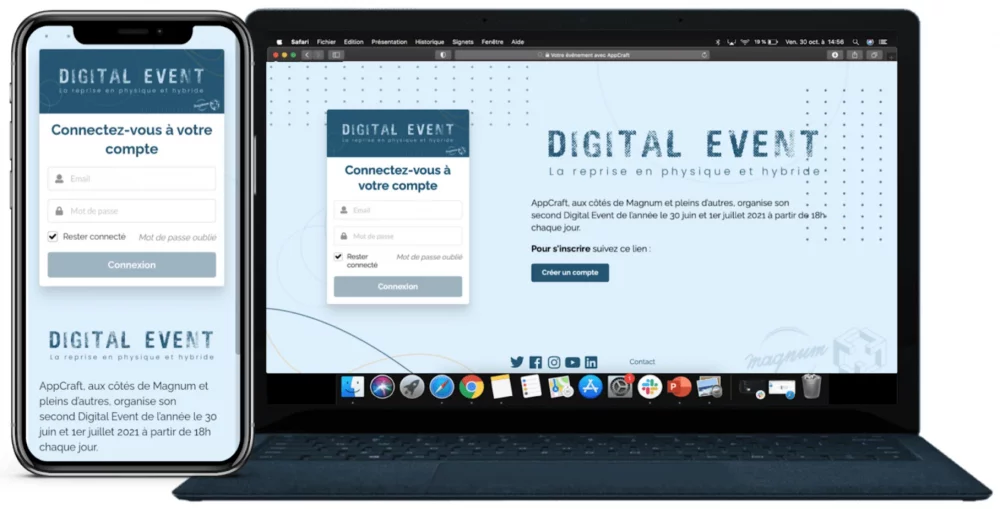
At AppCraft, we chose to adopt this new technology. Although we only offered native apps before COVID, we now offer the PWA to our clients. Why this turn? Because we are convinced of the benefits of this technology, which we added to our catalog during the COVID crisis to offer you the best possible service. This app will be very useful for in-person or hybrid events. As a compass, it will let your attendees find their way, and become active participants in their visit by choosing a personalized path. Individualized program, useful information available in advance, attendee directory: all the information is gathered in one and the same place.
We see several advantages for your events ✅
• The PWA benefits from a caching system, so most of the content is already loaded when you connect. Even without an internet connection! • It allows white label with customization of a manifest in the app's code (your name, logo and colors). This isn't possible for a native event app. • Most of your phone's features are accessible. For example your photos, if you want to take part in your event's Social Wall. • Interactivity is possible! Interact with other users on site or even remotely with chat or other networking features. Last but not least, the PWA has the advantage of being adaptive! So if you plan an in-person event and then the health situation (or something else) forces you to switch your event to hybrid or digital, there will be no problem. The PWA is responsive and adapts to screens of any size: computer, phone or tablet 👌
But does PWA really offer anything extra?
According to this study published by La Niche YES! According to them: Twitter saw a significant change in its numbers thanks to its PWA, compared with its native app: +65% pages per session, +75% tweets sent, –20% bounce rate. For Tinder: –50% load time on its PWA compared with its native app, which led to longer sessions. Pinterest: +40% time spent by users on its PWA than on its native app, +44% ad revenue, +60% user engagement. For more information on AppCraft's PWA and the possibilities for hybrid events or in-person events, don't hesitate to contact our Sales team at hello@appcraft.fr or on 09.72.51.22.90 ☎️
FAQ
What is the difference between a native app and a Progressive Web App (PWA)?
A native app is downloaded from an app store (App Store or Google Play) and installed directly on a smartphone. A Progressive Web App (PWA) runs in a web browser while offering an experience similar to that of a mobile app, without requiring a download. The choice depends on the event’s needs, the expected features, and the desired experience for participants.
Should you choose a native app or a PWA for an event?
Both solutions have their advantages. A native app offers optimal performance and advanced access to the phone's features, while a PWA is faster to deploy and easier for participants to access. The choice depends, in particular, on the number of participants, the duration of the event, and the organizer's objectives.
What solutions does AppCraft offer for event apps?
AppCraft offers solutions tailored to the various needs of event organizers, whether they require a native mobile app or a Progressive Web App (PWA). The platform centralizes the program, participants, communications, networking, notifications, check-in, and content to provide a seamless experience across all devices.
to change image ·