Agencies need a tool that can adapt to all types of events
An event agency may run, at the same time, a corporate convention, an international roadshow, a trade show, a press conference or a product launch. Each event has its own constraints, business goals and operational specifics. The problem with many event platforms is that they were designed for a single type of use. The result: teams have to multiply tools, work around certain limitations or adapt their event to the platform’s technical constraints. At AppCraft EVENTS, the goal is the opposite: let the tool adapt to the project, not the other way around. The event software was designed to let agencies manage different event formats in a single environment while keeping a strong approach to customization. This considerably reduces operational friction between project teams, clients and attendees. This flexibility becomes essential for agencies that want to industrialize certain processes without standardizing their events.
Registration management must become a strategic tool
For many agencies, registration is still seen as a mere administrative step. Yet it is now a real stake for attendee experience, qualification and business management. An event can bring together VIPs, partners, exhibitors, journalists, prospects, employees or speakers. Each has different needs, specific access and sometimes entirely separate journeys. Agencies must therefore be able to handle: • conditional forms, • approval workflows, • segmented access, • targeted invitations, • differentiated email campaigns, • or specific pricing rules. AppCraft EVENTS lets you build advanced registration logic without depending on a technical team for every change. Teams can quickly adjust attendee journeys based on client constraints, event goals or expected volumes. This ability to adapt becomes particularly important for high-volume events like trade shows, conventions or business meetings.
The event venue has become a key part of the brand experience
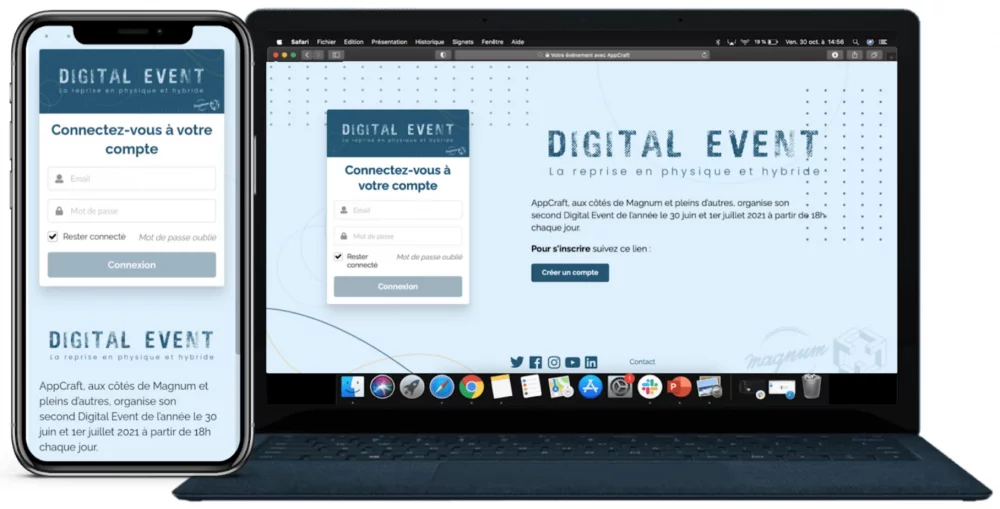
Today, the event website is no longer just a landing page. It is often the first contact between an attendee and the organizing brand. Within seconds, a visitor immediately perceives: • the level of professionalism, • the perceived quality of the event, • the consistency of the brand, • and the experience they can expect on the day. Yet many platforms still impose rigid structures that produce generic sites that all look alike. At AppCraft EVENTS, the approach rests on a simple idea: give agencies maximum freedom to build a digital experience truly consistent with their clients’ identity. Page structure, block organization, visuals, dynamic content, HTML integration, interactive modules or specific pages: agencies keep control of the experience offered to attendees. This customization not only strengthens the client’s brand image, but also improves engagement before the event even begins.
Centralizing operations is becoming essential for agencies
One of the main challenges for event agencies today is the proliferation of tools and points of operational friction. Between registrations, Excel exports, badges, emails, programs, QR codes, check-ins or statistics, teams often juggle several different platforms. This fragmentation slows operations and greatly increases the risk of errors. The value of a platform like AppCraft EVENTS is precisely that it centralizes all the event building blocks in a single environment. Teams can thus manage: • registrations, • communications, • the attendee CRM, • check-in, • badges, • statistics, • notifications, • and operational workflows. This centralization makes projects run more smoothly while letting agencies save considerable time in event production.
Participants now expect more interaction and networking
The attendee experience has become a central criterion for the success of a B2B event. Visitors no longer come just to attend conferences. They are looking for: relevant meetings, targeted exchanges, tailored content and more engaging experiences. Agencies must therefore offer setups able to improve interactions during the event. AppCraft EVENTS includes several features designed with this in mind: • networking, • matchmaking, • event mobile app, • quizzes, • social wall, • live Q&A, • gamification, • targeted notifications, • or meeting management. These tools let you create more dynamic events while bringing more value to organizers and sponsors. In trade shows, conventions or phygital events, these features are now a real differentiator.
AI and automation are already changing agencies' expectations
The event industry is evolving rapidly with the arrival of artificial intelligence and new approaches to automation. Agencies are now looking for tools that can speed up event production while maintaining a high level of customization. The goal isn’t just to save time, but above all to ease your teams' mental load and boost their delivery capacity. At AppCraft EVENTS, this evolution notably involves the integration of secure event AI features to streamline key tasks: • content generation, • mini-site creation, • workflow automation, • communications preparation, • and attendee journey mapping. This allows you to produce complex events faster without losing control over your digital strategy or brand identity. Today, this ability to combine automation, flexibility, and personalization is a major asset for modern event agencies.
FAQ
How can you determine whether an event platform is flexible enough for an agency?
By testing it against the actual diversity of its projects rather than a single typical scenario. An agency may simultaneously manage a corporate event, an international roadshow, a trade show, a press conference, and a product launch. The key question is whether the tool adapts to each project, or whether the event must adapt to the tool. Several points should be checked: modifying a user journey without a technical team, freely customizing the site (page structure, blocks, HTML integration, interactive modules), and managing all these formats within a single environment—as AppCraft allows.
How can we manage different registration processes based on participant profiles?
By building a registration system based on profiles rather than a one-size-fits-all form. VIPs, partners, exhibitors, journalists, prospects, employees, and speakers do not all have the same needs or the same access privileges. Several features work together: conditional forms, approval workflows, segmented access, targeted invitations, customized email campaigns, and specific pricing rules. With AppCraft, these workflows can be configured and adjusted without relying on a technical team, based on the client’s requirements or expected volumes. This is particularly useful for trade shows, conventions, and high-volume business events.
Does industrializing an agency’s processes necessarily mean standardizing its events?
No, as long as we distinguish between operational tasks and the user experience. Centralizing registrations, communications, badges, check-ins, statistics, and workflows in a single tool reduces the need for Excel exports, data re-entry, and the risk of errors. AI can also speed up the production of content and microsites. The pitfall is choosing a platform with rigid structures that produces generic sites that all look the same. With AppCraft, the agency automates repetitive tasks while maintaining control over each client’s brand identity and the experience offered to participants.
to change image ·