What is an eco-friendly event?
Eco-friendly events go beyond a handful of visible green gestures. They cover the event's entire life cycle: eco-design upstream (choice of venue, format, suppliers), control of the footprint during the event (energy, catering, waste, transportation) and impact measurement afterward. They also include social dimensions: accessibility, local roots, suppliers' working conditions. The first concrete step is a preliminary environmental assessment: identify the most significant sources of impact before deciding on priority actions. Without this assessment, you invest energy and budget in secondary levers while neglecting the most structural ones. Attendee travel generally accounts for 50 to 75% of an event's total carbon footprint, according to carbon footprints published using the ADEME methodology.
Checklist for a Successful Eco-Friendly Event
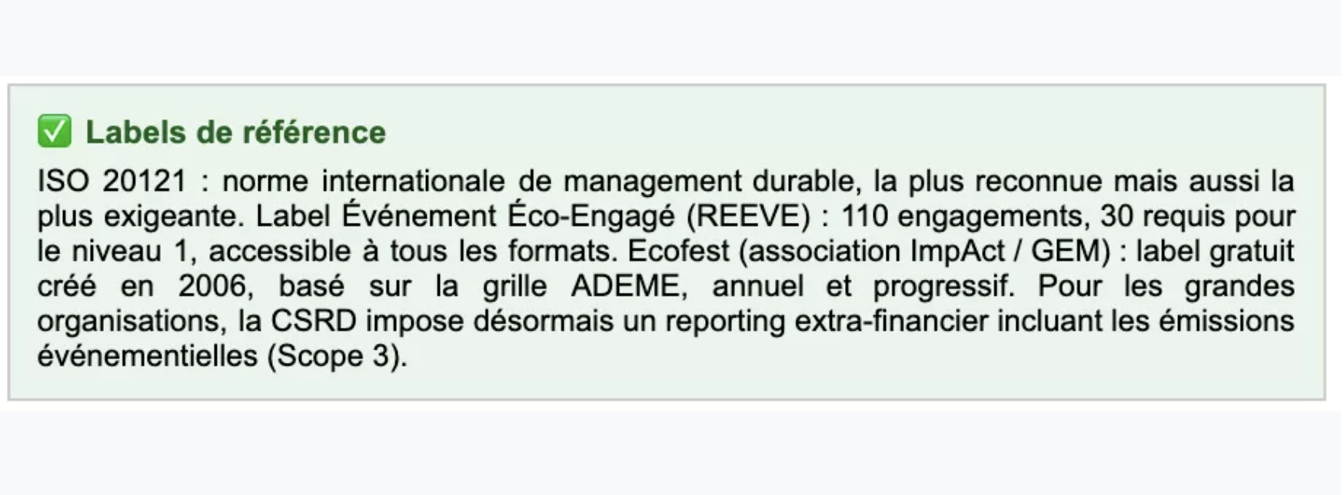
Here are the five areas to cover systematically to build a serious approach, whatever the size of the event. 🚉 Transportation and mobility: the first lever for carbon impact 1. Choose a venue accessible by public transit or train — this is the highest-impact lever. 2. Share low-carbon routes (train, bike, carpooling) with attendees ahead of time. 3. Offer a carpooling system or a partnership with a soft-mobility operator. 4. Collect attendees' travel modes through the registration form to measure the footprint. 🏛️ Venue, energy and infrastructure 5. Select a certified venue (ISO 20121, HQE, BREEAM) or one with a documented CSR commitment. 6. Avoid diesel generators; favor green electricity and LED lighting. 7. Limit temporary structures: favor existing, reusable venues over short-lived builds with a heavy material footprint. 🍽️ Catering and waste management 8. Make menus plant-based: switching from a meat-based meal to a mostly plant-based menu cuts the catering footprint by 50 to 70% (source: ADEME Base Carbone). 9. Favor short supply chains and certified caterers (ISO 20121, organic). 10. Eliminate disposable tableware and aim for zero single-use plastic. 11. Set up waste sorting and biowaste collection, and measure the quantities produced. 📳 Communication and event materials 12. Minimize printing: program, signage and invitations in digital format. 13. Cut unnecessary goodies; if you give a gift, choose a useful, local, eco-designed item. 14. Inform attendees about the eco-friendly approach without over-communicating on marginal actions. 📊 Measurement, carbon footprint and offsetting 15. Calculate a carbon footprint with recognized tools: Climeet, CLEO Carbone, the GoodPlanet calculator (based on the ADEME Bilan Carbone® methodology), and make it easy to automatically collect attendee emissions with AppCraft's carbon calculation module (free with our subscription plans). 16. If some emissions are unavoidable, consider offsetting through certified projects (Gold Standard, VCS) — as a last resort, never as a substitute for real reductions. 17. Publish the results, including areas for improvement. Consider a recognized certification (ISO 20121, REEVE's Événement Éco-Engagé label, Ecofest).
Why is eco-friendly event planning becoming a must for brands?
An organization's environmental commitment is no longer limited to its products: the events it organizes have become spaces where it expresses its values, scrutinized by attendees, partners and the media. Two levers are accelerating this shift. On one side, the expectations of customers and employees. According to a NielsenIQ survey (2023), 72% of Europeans say they're willing to pay more for sustainable, eco-designed products — a willingness that also shows up in which events they choose to attend. The generation now entering the workforce treats environmental commitment as a criterion for choosing an employer, not a bonus. On the other, a tightening regulatory framework. France's Climate and Resilience Act (2021) made greenwashing a misleading commercial practice under the Consumer Code. The European Empowering Consumers directive, whose transposition is expected in 2026, strengthens these obligations. The CSRD requires large companies to produce detailed non-financial reporting that includes indirect emissions — including those linked to events.
How does a long-term commitment strengthen your brand’s reputation and credibility?
Turning a seminar or conference into a CSR showcase An internal event — executive seminar, annual convention, onboarding day — is one of the most powerful spaces to bring an organization's environmental commitments to life. It's not a speech: it's an experience lived by employees themselves. A few concrete activations: include an awareness workshop (the Fresque de l'événementiel, a tool developed by the REEVE network), display the event's impact indicators in real time on the venue's screens, partner with a local social-inclusion or urban-farming nonprofit, choose a third place or a demonstration site for the ecological transition as the venue. These choices create legitimate talking points and are a lasting HR and commercial differentiator. Post-event communication levers to activate After the event, publishing the carbon footprint — even incomplete, even imperfect — is a strong act of transparency. Share key figures (waste avoided, share of attendees who came by train, plant-based share of menus) internally and on social media, produce a concise impact report, collect attendee testimonials. The key is transparency about actual results, including areas for improvement. A report that acknowledges its limits ("air travel still accounts for 60% of our footprint and remains our main area of work") is far more credible than polished communication. This is the stance ADEME recommends in its 2025 anti-greenwashing guide.
Mistakes to Avoid to Prevent Falling into Event Greenwashing
Recognizing the warning signs of greenwashing Event greenwashing takes many forms. First, disproportionate communication: touting the removal of plastic water bottles at the top of your report without mentioning that 300 attendees flew in. Second, overuse of vague terms: "green event," "carbon neutral" with no stated assumptions or methodologies. France's Climate and Resilience Act (2021) already prohibits claims like "carbon neutral" or "environmentally friendly" without evidence. Relying exclusively on carbon offsetting is another common pitfall. Buying carbon credits to "offset" without having reduced first is not considered sufficient by ADEME. The order is clear: avoid, reduce, then offset the residual. Best practices for credible environmental messaging Credible environmental messaging rests on four pillars. First, measurement: you can only communicate about your impact if you've quantified it with a recognized method. Second, proportionality: communicate about actions in line with their actual impact reduction. Third, full treatment of the footprint: cover the entire scope, not just the flattering items. Fourth, comparison with a baseline: "compared with the previous edition, we reduced our emissions by 15%" is far more credible than an absolute figure with no reference.
In conclusion
Organizing an eco-friendly event is a gradual process, not instant perfection. The most successful first edition is the one where you did an assessment, identified your two or three priority levers and measured your results, which you then build on. Continuous improvement, documented and transparent, is infinitely more credible than an event claiming to be "perfectly green" from day one. Beyond the events themselves, related topics deserve the attention of committed organizers: accessibility and inclusion as full components of a responsible event, automated collection of impact data through event platforms (registration form that captures travel mode, post-event satisfaction survey), and building a CSR events policy across an entire organization.
FAQ
Where should you start to reduce an event’s carbon footprint?
Through an assessment that identifies the largest sources of emissions, to avoid investing in secondary measures. In most cases, participant transportation is the largest source: it accounts for 50 to 75 percent of the total carbon footprint, according to assessments conducted using the ADEME methodology. Choosing a venue accessible by train or public transportation is therefore the most effective lever, followed by promoting low-carbon travel options and carpooling. Catering comes next: a plant-based menu reduces its carbon footprint by 50 to 70 percent. With AppCraft, the registration form can collect information on each participant’s mode of transportation.
How do you calculate an event's carbon footprint?
By using a tool based on a recognized methodology and then comparing the results from one event to the next. Tools such as Climeet, CLEO Carbone, and the GoodPlanet calculator are based on ADEME’s Bilan Carbone® method. AppCraft’s carbon calculation module, which is free with subscription plans, automatically retrieves participants’ travel-related emissions from their registration data. The assessment must cover the entire scope, not just the most favorable categories. It gains credibility when published along with its limitations—for example, by acknowledging that air travel remains the biggest challenge.
How can you avoid greenwashing in event communications?
By communicating the actual impact—and only what has been measured. The classic pitfall is to highlight the elimination of plastic bottles while failing to mention that hundreds of participants flew in. Claims such as “carbon neutral” or “environmentally friendly” without evidence have been prohibited since the 2021 Climate and Resilience Act. Carbon offsetting should only be used as a last resort, following the order recommended by ADEME: avoid, reduce, then offset. A figure compared to the previous edition—such as “−15% emissions”—is far more credible than a general promise.
to change image ·