Why perform calculations early in the design phase
Measuring after the fact lets you take note. Measuring beforehand lets you act. That's the difference between a post-event audit, useful but descriptive, and an eco-design approach that makes carbon impact a decision criterion from the choice of venue, format and caterer. At that stage, the structuring decisions are still open. Afterward, they no longer are. Transportation illustrates this clearly: choosing a venue reachable by train rather than by plane can divide travel emissions by five to ten, depending on where attendees come from (source: ADEME Base Carbone). This decision is made upstream, when choosing the site. Once the venue is signed, the opportunity has passed. The regulatory context reinforces this imperative. The CSRD (Corporate Sustainability Reporting Directive) requires companies above a certain size to produce non-financial reporting including their direct and indirect emissions. Events, which fall under organizations' Scope 3, are within scope. Those who have already put in place a calculation method at the event level will be much better prepared for these obligations.
How is the calculation done? Scope and method
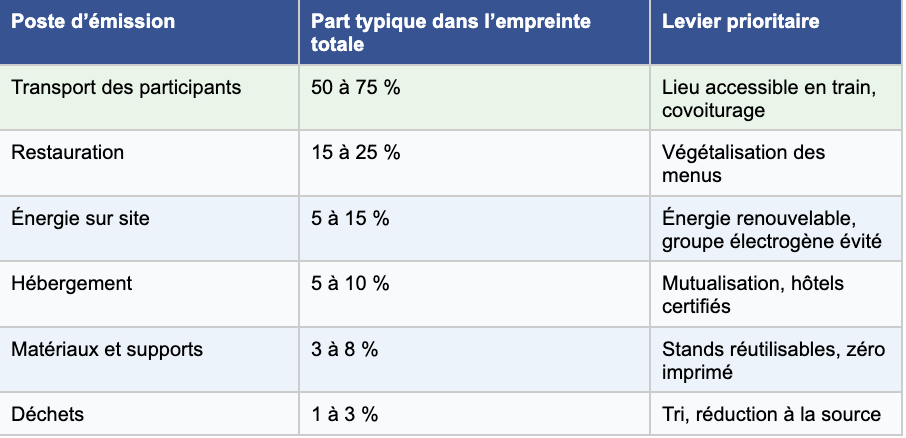
The reference method in France is the Bilan Carbone®, originally developed by ADEME in collaboration with Jean-Marc Jancovici, and now carried by the Association Bilan Carbone (ABC). Its principle rests on collecting activity data (kilometers traveled, kilos of waste produced, kWh consumed...) that is multiplied by emission factors to obtain tonnes of CO₂ equivalent (tCO₂e). It applies to the events scope with specific adaptations. Defining the scope: Scope 1, 2 and 3 in an events context The distinction between the three scopes takes on particular meaning in events. Scope 1 covers the organizer's direct emissions: on-site diesel generator, vehicles owned by the organization. Scope 2 covers purchased energy: electricity at the venue, air conditioning, lighting. Important, but rarely decisive. Scope 3 is the essential one. It gathers all indirect emissions: transportation of attendees (including providers and speakers), accommodation, catering, production of printed materials, booths and signage, waste. This scope typically accounts for between 70 and 90% of an event's total footprint. That's where most of the action is, and it's also where reduction levers are most powerful. A good practice is to define clear boundaries before the calculation: geographic scope (which origin of attendees is taken into account?), number of people included (attendees, speakers, providers, staff?), period covered (including setup and teardown?). These choices must be documented so the calculation can be reproduced from one edition to the next. The priority emission sources to watch A systematic analysis of available event carbon footprints reveals a relatively stable hierarchy, whatever the format. Transportation dominates massively, followed by catering, then energy. These proportions vary by type of event and by where attendees come from. A regional event where all attendees arrive by train will have a very different profile from an international conference where half the attendees come by plane.
Types of events and their environmental impact
Corporate conferences and seminars The corporate seminar is often underestimated because it seems “small.” Yet a two-day residential seminar for 100 people, with travel included, can generate between 20 and 60 tCO₂e depending on the modes of transport used and where attendees come from. Brought down to the individual, the footprint can represent several hundred kilos of CO₂e per person, the equivalent of a round-trip flight from Paris to Barcelona. The key is the location and accessibility of the venue. A seminar at a property well served by public transport, with mainly Île-de-France attendees, will have a radically different transport footprint from a seminar at an isolated luxury hotel reachable only by car. Festivals, trade shows and large gatherings The scale effect radically changes the size of the problem. A marginal item per attendee becomes massive at 10,000 people. Data collected by the Convention des Entreprises pour le Climat (CEC) at one of its sessions in Marseille (about 200 attendees) identified transportation as nearly 45% of emissions, and purchases (catering and accommodation) as 36% (source: CEC report, published on LinkedIn). The small items imagined to be significant, such as printed materials and decoration, often turn out to be secondary. Transportation, on the other hand, systematically dominates. Large events have also begun to measure and communicate their results. The approach is gradually becoming a standard of CSR credibility, notably in sectors where brand image is strategic. Hybrid events: an underestimated lever The hybrid format (in-person + remote) is often presented as a miracle solution. The figures confirm this to a certain extent: a study by the firm WSP covering seven events showed that a virtual conference of 560 attendees generated 10 tCO₂ where its in-person equivalent would have produced 274 (source: WSP report, cited by Evenement.com). For a convention of 18,000 people, the figures were 176 and 10,348 tCO₂ respectively. An important nuance: hybrid generates its own digital emissions (streaming, data centers, remote attendees' equipment). These emissions remain low in absolute terms compared with the transport avoided, but they must be included in the calculation to stay rigorous. Partial hybridization is a powerful lever when it is planned upstream, not added as a last resort.
A review of a sustainable event
Measuring your carbon footprint is the first step of a responsible approach. But raw data isn't enough: it has to be read, interpreted in context, and turned into a concrete action plan. That's where the approach takes on its full meaning. The Fresque de l'événement: a collective awareness tool Before getting into the numbers, you often need to create the cultural conditions for the carbon approach to be accepted and carried collectively. That's the purpose of the Fresque de l'événementiel, developed by the REEVE association (Réseau éco-événement): a half-day collaborative workshop, inspired by the Fresque du Climat, designed specifically for events industry professionals. Who is this workshop for and how can it be built into a CSR approach? The Fresque de l'événementiel is aimed at events teams, at agencies looking to train their employees, and at executive committees preparing a CSR plan. Unlike a lecture, it creates a systemic understanding of the sector's impacts through collective intelligence: each participant actively builds their own picture of the links between events, climate disruption and social issues. In a structured CSR approach, the Fresque occupies a specific position: it raises awareness and creates the desire to act, where the carbon footprint quantifies and prioritizes. The ideal sequence is: Fresque (collective awareness) → Carbon footprint (measurement and quantification) → Action plan (prioritization and decision). The workshop can also be used to relaunch an ISO 20121 approach or to inject momentum into an internal working group.
Analyze the results and develop an action plan
Reading and interpreting your event carbon footprint An event carbon footprint cannot be interpreted in isolation. It must be put in context in terms of the type of event, size, geography, and previous editions if any. The first read should identify the “hot spots”: the two or three items that account for more than 80% of emissions. That's where the reduction effort should focus, not on symbolic actions affecting 2% of the footprint. To track your progress over time, it is recommended to document precisely the assumptions and the activity data used for each edition. Without that, it is impossible to know whether a year-on-year change reflects a real reduction or a change of scope. A ratio in tCO₂e per attendee is more useful than an absolute figure for comparing events of different sizes. What organizations have learned: lessons from experience The most consistent lesson from all published event carbon footprints is the omnipresence of transportation. Organizers who have never measured often think printed materials, decoration or energy are their main items. The calculation systematically reveals that transportation, notably planes and individual cars, dominates with a share of 50 to 75% of the total footprint. Another common lesson: the difficulty of data collection. Getting reliable information on attendees' modes of transport, or on emissions associated with providers, is often the main operational obstacle. This finding argues for building data collection (a registration form with a question on mode of transport, contractual clauses for providers) into standard processes, rather than after the fact.
Emissions reduction scenarios and selection of responsible service providers
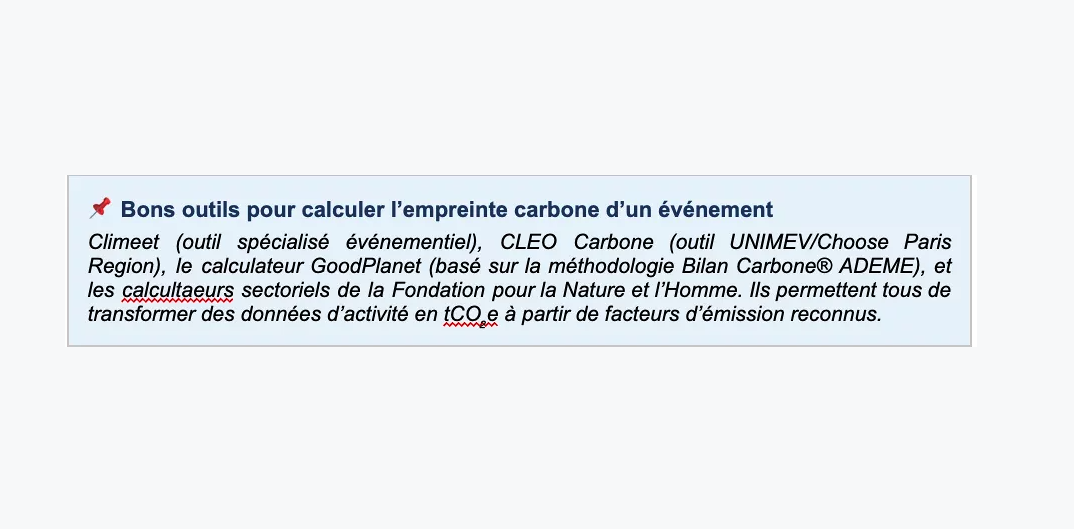
Acting on high-impact levers The hierarchy of action to remember is: avoid first, reduce next, offset as a last resort. Carbon offsetting, the purchase of carbon credits tied to reforestation or carbon capture projects, should not be presented as a primary solution. ADEME explicitly warns against “carbon neutrality” claims and recommends favoring real reduction. The high-impact levers, in order of effectiveness: Choose a venue accessible by public transport or train: this is the most powerful lever. Reduce or even eliminate air travel by favoring a central location. Shift menus toward plant-based: going from a red-meat meal to a vegetarian meal reduces the catering footprint by 50 to 70% (source: ADEME Base Carbone). Limit printed materials and goodies: little absolute impact, but a strong signal and easy to activate. Pool accommodation and guide attendees to hotels reachable on foot. Use reusable modular booths rather than disposable builds. How do you select providers aligned with your CSR approach? A provider that cannot supply its own emissions data cannot be seriously integrated into an event carbon footprint. The ability to supply this data is therefore a selection criterion in its own right. Beyond that, labels give benchmarks: ISO 20121 is the international reference standard for responsible event management, and the European Ecolabel and the Lucie label certify an overall CSR approach. Including environmental clauses in tenders is a still-rare practice but a growing one: an obligation to provide a carbon footprint of the service, a commitment on the share of renewable energy, a waste management policy. These clauses change conversations with providers and accelerate the sector's transformation.
In conclusion
Calculating an event's carbon footprint is now within reach of any organizer, with the right tools and a clear method. The main obstacle isn't technical: it's deciding to start, ideally from the design phase of the next event. Waiting for a perfect footprint before acting is the best way never to begin. Calculating the carbon footprint fits naturally into a broader CSR approach: an impact report, transparent communication with attendees and clients, continuous improvement from one edition to the next. It also opens onto other related topics we will keep exploring: waste management at events, accessibility and inclusion as components of a responsible event, and the growing role of digital tools in automated collection of event activity data.
FAQ
Should an event’s carbon footprint be calculated before or after the event?
Ideally, this should begin at the design stage—not just afterward. A calculation made after the event merely provides insight; a calculation done in advance allows for action to be taken while key decisions are still open: venue, format, and catering. For example, choosing a venue accessible by train rather than by plane can reduce travel-related emissions by a factor of five to ten, depending on where participants are coming from (ADEME Carbon Database). Once the venue is booked, this option is no longer available. For companies subject to the CSRD, events fall under Scope 3: having a method in place for each event simplifies this reporting. AppCraft’s carbon module allows you to incorporate this calculation right from the registration stage.
How do you define the scope and collect data for an event’s carbon footprint assessment?
By defining the scope of the calculation before beginning, and then integrating data collection into standard processes. You must decide which geographic locations of participants to consider, which people to include (participants, speakers, service providers, staff), and what time period to cover, including setup and takedown. These choices must be documented to ensure the calculation is comparable from one edition to the next. Scope 3 (transportation, lodging, food service, materials, and waste) generally accounts for 70 to 90 percent of the carbon footprint. The AppCraft registration form can collect information on each participant’s mode of transportation, and contractual clauses allow for the collection of data from service providers.
Does a hybrid format really reduce an event's carbon footprint?
Yes, significantly, but not to zero. A study by WSP covering seven events estimates that a virtual conference with 560 participants generated 10 tCO₂, compared to 274 tCO₂ for its in-person equivalent. For a convention with 18,000 attendees, the difference ranged from 176 to 10,348 tCO₂. On the other hand, the hybrid format produces its own digital emissions (streaming, data centers, participants’ equipment), which must be included in the carbon footprint calculation to ensure accuracy. These emissions remain low compared to the transportation avoided. Hybrid events are most effective when planned in advance, and AppCraft makes it possible to manage both on-site and remote participants within the same event.
to change image ·