What is event marketing?
Definition and stakes for companies Event marketing refers to all the marketing actions carried out around an event: organizing a trade show, sponsoring a conference, launching a product live, running a webinar, staging a brand activation. The event is not an end in itself; it is a vehicle serving precise marketing goals: generating leads, strengthening awareness, retaining customers, recruiting talent, or asserting a strategic positioning. What sets it apart is the nature of the interaction it creates: unlike traditional digital channels (email, advertising, social media), an event produces a direct, multisensory and memorable experience. A study cited by Meltwater indicates that 73% of consumers say they are more likely to buy a product after attending a branded event. This figure illustrates the difference in conversion between passive exposure to a message and active participation in an experience. The key goals of an event strategy An effective event marketing strategy always starts by defining one main goal. The most common: generating qualified leads, accelerating the sales pipeline, retaining existing customers, strengthening brand awareness, or launching a product or service. The goal is not neutral: it determines the event format, the profile of the audience to invite, the messages to deliver and the metrics to track. An event designed to generate leads isn’t rolled out the same way as one meant to retain existing customers.
The Different Types of Event Marketing
In-person, virtual and hybrid events The event format is the first strategic decision. In-person remains the most engaging format: it creates spontaneous interactions, makes networking easier and produces moments of emotion that digital can’t reproduce exactly. Virtual considerably widens the accessible audience, cuts logistics costs and carbon footprint, but demands a higher level of facilitation and interactivity to hold attention. Hybrid combines the two: an in-person core and a remote component, making it possible to reach geographically dispersed audiences without giving up the quality of face-to-face exchange. It’s the format that has grown the most since 2021 and its growth should continue in 2026-2027. Trade shows, conferences and brand experiences Trade shows and conferences are the most classic formats of B2B event marketing. Their strength: bringing a highly qualified audience, predisposed to business conversations, together in one place at one time. Brand experiences, also called “brand experiences” or activations, follow a different logic: rather than informing, they seek to create an emotion, a memory and a positive association with the brand. These formats are favored for product launches, high-end customer relations operations and image campaigns. Sponsored events and field activations The company is not always the organizer: it can also be present as a sponsor or partner of a third-party event. Event sponsorship gives access to a pre-qualified audience without bearing all of the organizing costs, provided you negotiate enough visibility and activation rights. Field activations are physical setups deployed in public space or at events: booths, product demos, games, interactive installations. Their value is reaching a broad, less captive audience by creating a memorable moment of contact that is often shared on social media.
How to Develop an Effective Event Marketing Strategy
Defining your targets and key messages Audience segmentation is the foundation of any serious event strategy. A single event can bring together several profiles: prospects to convert, customers to retain, partners to engage, press to convince. Each expects a tailored message and experience. Defining event personas (who are they? what do they expect? what arguments will make them act?) lets you design a program, communications and an attendee journey that are truly differentiated by group. The event’s key message, the central value promise that attendees will remember, must be defined first. All the content, speakers, workshops and communications flow from it. Without this common thread, the event risks feeling fragmented and forgettable. Choosing the right format and the right distribution channels The choice of format depends on the target audience, budget, geography and goal. An annual conference positions the company as a reference in its sector; a monthly webinar nurtures the commercial relationship over time; a prospect lunch creates an informal setting that helps speed up the sales cycle. Distribution channels (email, social media, press relations, co-promotion partnerships, SEO) must be activated in a complementary way, with a logic of progression: awareness, then conversion, then retention. The event management platform is the tool that lets you centralize registrations, communications and data, and automate communication sequences before, during and after the event.
Inspiring examples of successful event marketing
Real-world cases from major international brands Salesforce Dreamforce is one of the most-cited tech conferences: each edition brings together tens of thousands of attendees in San Francisco and hundreds of thousands remotely. The event has become a marketing asset in its own right: it speeds up the Salesforce sales cycle, generates massive media coverage and positions the company as a category leader. Apple, for its part, has turned its Keynotes into cultural events: they are no longer just product launches but moments of collective emotion, broadcast live to millions of viewers, that build anticipation and desire well before the product goes on sale. These examples illustrate a fundamental principle: brands that excel at event marketing don’t treat their events as isolated episodes, but as recurring strategic assets that strengthen their positioning year after year. Examples suited to SMBs and local players Event marketing isn’t reserved for big brands. A consulting firm that hosts a monthly breakfast for about ten HR directors in its region creates a high-value space for exchange that strengthens its credibility and speeds up its sales conversations with no direct sales pressure. An industrial SMB that invites its key customers to an open house around a technical innovation combines product demo, customer retention and referrer generation in a single event. In both cases, the key to success is the same: a format calibrated to the target audience, content that provides real value (information, network, expertise), and a sales follow-up organized in the days after the event. The number of attendees matters less than the quality of the targeting and the quality of the follow-up.
Event ROI: How to Measure the Success of Your Initiatives
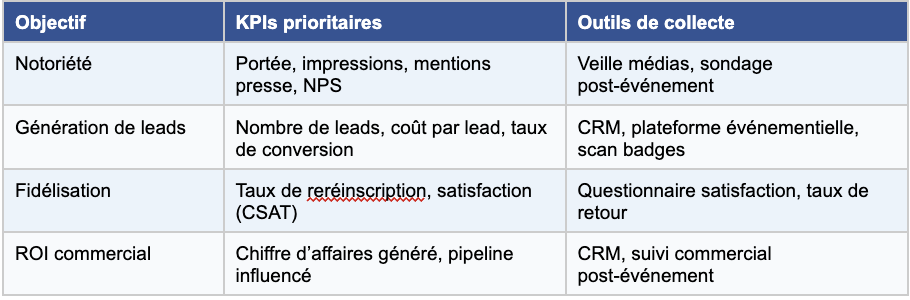
The key performance indicators (KPIs) to track An event’s KPIs are not universal: they depend directly on the goal set upfront. An event designed to generate leads will be assessed on the number of qualified contacts collected, the cost per lead and their conversion rate in the following weeks. An awareness event will be assessed on media reach, the volume of social media mentions and the change in brand perception measured by survey. One indicator deserves particular attention: the actual attendance rate versus registrations. A large gap between registrations and actual attendance often points to a problem with the message, timing or follow-up. The post-event NPS (Net Promoter Score) is an excellent indicator of the quality of the perceived experience and the likelihood of re-registration or recommendation. Tools and methods for calculating return on investment Event ROI is calculated with the classic formula: (value generated − total event cost) / total cost × 100. The difficulty lies in defining the “value generated”, which is not limited to the revenue immediately resulting from the event. It also includes the influenced sales pipeline, the value of the relationships activated (partnerships, referrers), and the value of the data collected. This broader view is essential to avoid systematically undervaluing events whose commercial impact materializes at 3 or 6 months. Event management platforms play a key role in this measurement: by centralizing registration, attendance, on-site engagement and post-event satisfaction data, and connecting it to the sales CRM, they let you track an attendee’s full journey from invitation to conversion. Without this traceability, ROI remains an estimate; with it, it becomes a decision-making argument.
Event Marketing Trends in 2026
The rise of hybrid events and data Hybridization is no longer a constraint born of the health crisis: it has become a deliberately chosen strategy for extending the audience. Pairing a strong in-person core with polished digital broadcasting lets you reach international audiences, enrich the content with remote speakers and extend the life of the event beyond the big day with replays and derived content. At the same time, data plays a growing role in decision-making: organizations that systematically measure the impact of their events gradually expand their event budget by defending it with hard numbers. Personalization and community engagement Attendees expect standardized events less and less: they want experiences designed for their profile, interests and level of maturity. Personalization extends to the program (sessions recommended by profile), to communications (invitation email tailored to the segment) and even to the badge and welcome on the day. This personalization is made possible by event platforms that centralize attendee data and let you trigger automatic segmentation rules. The other structuring trend is the event as a lever for building community. Rather than organizing isolated episodes, the most advanced brands build recurring event calendars (annual conference, monthly webinars, quarterly breakfasts) that keep an active community going all year long. This approach lowers the cost of acquiring attendees edition after edition and builds a lasting reputational asset. 📌 AppCraft and event marketing AppCraft supports marketing teams in carrying out their event strategy: registration and invitation management, audience segmentation, automated multichannel communication, on-site check-in, attendance data collection and a steering dashboard. The goal: reduce the operational load so you can focus your energy on what creates value, the quality of the content and of the attendee experience.
In conclusion
Event marketing is one of the most demanding forms of marketing, and one of the most rewarding when well executed. It takes time, resources and expertise; in return it produces qualified relationships, actionable data and memorable experiences that other channels can’t create. To go further, several topics are worth exploring: building a coherent annual event calendar, integrating event tools into the overall marketing stack (CRM, marketing automation), and the growing role of AI in personalizing the attendee experience. These are all levers we will keep exploring to help organizers get the most out of their event investment.
FAQ
In-person, virtual, or hybrid events: Which format should you choose for your marketing strategy?
The choice depends on the target audience, budget, geography, and objective. In-person events remain the most engaging format: they foster networking, spontaneous interactions, and emotional moments. Virtual events significantly expand the audience and reduce logistical costs as well as the carbon footprint, but they require more active facilitation to maintain attention. The hybrid format combines an in-person core with remote participation, which is useful for reaching dispersed audiences without compromising the quality of interactions. With AppCraft, registrations, communications, and data remain centralized regardless of the format chosen.
How do you calculate the return on investment for a marketing event?
The basic formula is: (value generated − total cost) / total cost × 100. The challenge lies in clearly defining the value generated. Beyond immediate revenue, it includes the sales pipeline it influences, the relationships it fosters (partners, influencers), and the data collected—the impact of which often becomes apparent after 3 or 6 months. The metrics to track depend on the objective: qualified leads, cost per lead, and conversion rate for lead generation; or media reach and mentions for brand awareness. AppCraft centralizes registration, attendance, engagement, and satisfaction data, and links it to the CRM to track each participant through to conversion.
Why might a marketing event fail to produce the expected results?
Most often, this is because the objective wasn’t established from the start. Yet it is the objective that determines the format, the audience, the messages, and the metrics to track. Without a clearly defined key message, the event comes across as disjointed and forgettable. Another common mistake is failing to follow up with sales efforts in the days after the event, or treating each event as a one-off rather than a recurring occasion. A significant gap between the number of registrants and attendees usually indicates a problem with the message, timing, or follow-up. With AppCraft, follow-ups and communications before and after the event can be automated.
to change image ·