Define your communication goals
This is the non-negotiable starting point. Without clear goals, the rest of the plan floats in the void: you don’t know what to measure or how to allocate your resources. The SMART framework (Specific, Measurable, Achievable, Realistic, Time-bound) applies perfectly to event communication. Here is the difference between a vague goal and an actionable one: “increase registrations” is useless; “reach 300 registrants within 6 weeks of ticketing opening” is usable. Three types of goals coexist in any event communication campaign. Awareness goals (examples: 10,000 social media impressions on the big day, getting 5 press mentions). Engagement goals (500 interactions on the event page, a 40% open rate on invitation emails). Conversion goals (reaching an 80% fill rate, generating 200 qualified leads at a trade show). The key is to align these communication goals with the event’s business goals: revenue, partnerships, brand awareness. The two dimensions must converge, otherwise the communication stays disconnected from the expected result.
Market Context and Analysis
Before defining your message or activating your channels, a prior intelligence phase is a must. It covers three dimensions. First, the competitive environment: are there other events in the same period, in the same sector or for the same target? What do they offer? Then the industry context: news, trends, seasons. A CSR trade show launched at the same time as a major climate summit benefits from favorable momentum; a B2B event launched in August will suffer from saturated, empty inboxes. Finally, your own resources: communication budget, team size and skills, available tools. This analysis brings out two operational concepts. • The communication window: when should you launch promotion to be visible without being drowned out? Depending on the nature of the event, this window opens 3 to 6 months ahead for a large-scale conference, or 4 to 6 weeks for a more one-off local event. • Differentiation: what sets your event apart from everything that already exists in this segment? The answer to this question directly feeds your key message.
Target segmentation and audience insight
Trying to talk to everyone means talking to no one. A professional event generally brings together several distinct segments: potential attendees (several possible profiles depending on the format), partners and sponsors, press and industry influencers, and “alumni”, meaning attendees of previous editions. Each segment has its own motivations, barriers to registering and preferred channels. The event persona tool is very useful here: a concise sheet per segment that lists the typical profile, their expectations of the event, their objections and the messages likely to overcome them. Concretely, the message sent to a marketing director won’t be the same as to an operational project manager: the former will look for strategic insights and high-level networking; the latter, for concrete solutions and practical cases. Adapting the message to each segment avoids undifferentiated blasting and optimizes every euro of communication budget. Choosing the right event management tool is crucial to let you segment your audience as finely as possible and have an intuitive solution to send the right message, at the right time, to the right person. Most solutions on the market force you to segment your guest list manually with a “VIP”, “companion”, “press” tag, etc… but sometimes you need to create rules like “if a guest has such and such characteristics, then they belong to such a segment”. Segmentation can then be automatic across your entire database. It’s a significant time saver and a safeguard that AppCraft offers natively.
Identify key messages and the communication strategy
A key message in the event context is the event’s central promise: what attendees will experience, learn or take away, worded in a simple, memorable and differentiating way. The distinction between a weak message and a strong one is decisive. “Come to our conference on digital transformation” is a weak message: it describes the event without creating desire. “Two days to completely rethink your digital strategy with the 50 leaders transforming their industry” is a strong message: it states a precise value promise and creates the urge to attend. From this main message, you roll out secondary messages tailored to each segment: detailed program and speakers for operational attendees, impact and visibility for potential sponsors, topic angle and exclusivity for the press. All converge on the same guiding theme. It’s this brand consistency, applied across all visuals, emails, posts and press relations, that guarantees immediate recognition of the event at every touchpoint.
Choosing the right distribution channels
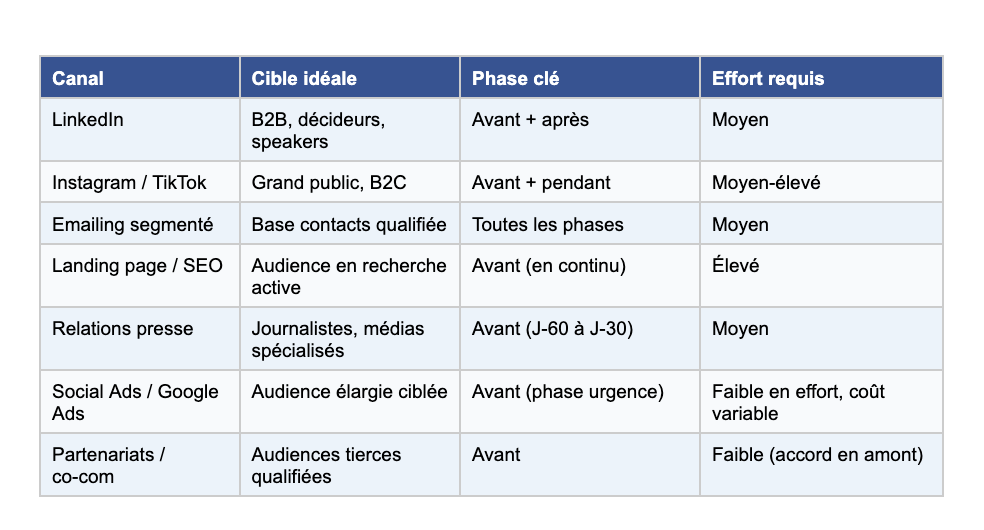
The task is not to choose the most popular channel, but the one best suited to your target, your message and the moment in the campaign. The logic is one of multichannel complementarity: a single channel is never enough, and it’s the consistency between channels that creates impact. A few key principles: LinkedIn is a must for B2B events and offers native tools (event page, post boost) that are particularly effective for the pre-event phase. Emailing remains the highest-converting channel for registration, provided the list is qualified and the messages are segmented. The dedicated landing page is the central hub all other channels must point to: it must be optimized for conversion (short form, social proof, visible CTA).
Choosing the right content formats
The choice of format depends on the channel, the communication phase and the goal of the moment. A good event communication plan alternates three types of content: informational content (program, speakers, registration terms), emotional content (promise of experience, testimonials from past attendees, behind-the-scenes preparation) and incentive content (countdown, early bird offer, registration closing reminder). A few effective pairings: the teaser video (30 to 60 seconds) for the launch on LinkedIn and Instagram, the speaker interview published as a blog article for SEO and as an excerpt on social networks, the Instagram or LinkedIn carousel to detail the program across several slides, the dedicated newsletter for the existing database, the infographic to share key figures about the upcoming edition. The format must serve the message, never the other way around: a hastily made video does more harm than a well-written text post.
In conclusion
A digital, multi-channel event communication plan is not a series of isolated actions: it is a logical progression, from the objectives through to the post-event analysis, where each step determines the next. The key to success can be summed up in three words: consistency, progression, and measurement. Consistency of the message across all channels. Progressive communication over time. Systematic measurement to improve each edition.
FAQ
Which channel is best for promoting a B2B event?
No single channel is enough on its own: it’s their synergy that makes an impact. LinkedIn is essential in B2B, especially during the launch phase, thanks to its native tools such as event pages and post boosts. Email marketing remains the channel that converts best into registrations, provided the list is qualified and the messages are segmented. All channels should then direct users to a dedicated landing page, optimized for conversion with a short form, social proof, and a visible registration button. With AppCraft, the event website and segmented email marketing are combined into a single tool.
How can you segment your audience to tailor your event messaging?
By identifying the major segments and then creating a persona profile for each one. A professional event typically brings together potential attendees with diverse profiles, partners and sponsors, the press and industry influencers, as well as attendees from previous editions. Each profile describes the typical participant, their expectations, their objections, and the messages that can address those objections. For example, a marketing director might be looking for strategic insights and networking opportunities, while a project manager might be seeking practical case studies. Rather than manually adding tags, AppCraft automatically segments the database based on rules defined by guest characteristics.
Why might marketing for an event fail even with a good program?
This is often due to a message that’s too weak, vague objectives, or poor timing. “Come to our conference on digital transformation” describes the event without creating any desire to attend. A specific promise, such as “Two days to rethink your digital strategy with 50 executives who are transforming their industry,” makes people want to come. A vague objective, such as “increase registrations,” also makes it impossible to measure results. Finally, timing matters: launching a B2B event in August or at the same time as a competing event reduces its visibility. The communication window generally opens 3 to 6 months before a major conference, and 4 to 6 weeks before a local event.
to change image ·